


Short Chapters, Long Commutes
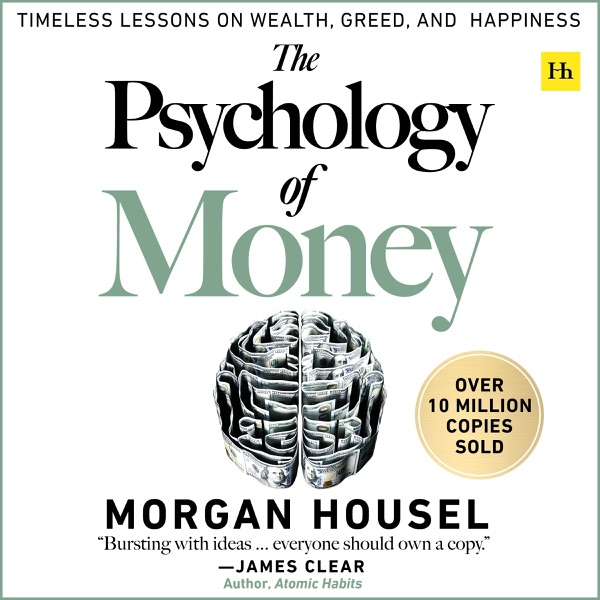
I listened to this during my morning drive—twenty minutes one way, forty minutes round trip—and I kept hitting the rewind button at red lights, backing up to catch something I’d just heard. So let’s get into the Psychology of Money audiobook. Housel’s chapters are exactly the length a commute needs: self-contained, punchy, each one a complete thought that doesn’t require you to hold a thread for three hours. Chris Hill’s narration is conversational without being cutesy; he reads like someone explaining something he genuinely believes over coffee. At 5 hours and 53 minutes, The Psychology of Money is digestible in pieces without losing coherence, which matters because the book’s entire thesis—that most money decisions are emotional, not mathematical—needs time to settle into how you actually think.
The Real Argument
Housel doesn’t sell you a system. He doesn’t promise a formula or a four-step plan to wealth. Instead, he builds a case that how we behave around money matters infinitely more than what we know about interest rates or asset allocation. It’s a psychological book masquerading as finance advice, and that’s its core strength. Each chapter zooms into a behavioral truth: why people who work hard still go broke, why luck plays a bigger role than we admit, why staying invested is harder than picking the right investment. The argument is disarmingly simple, but proving it requires stories and examples—and this is where the audio format becomes crucial.
Hearing these narratives aloud, voiced by Hill, gives them weight in a way print can’t quite match. A print reader might skim a chart; an audiobook listener hears the numbers embedded in a sentence, feels the pause after a punchline, absorbs the rhythm of Housel’s prose. The author’s own voice comes through Hill’s reading—measured, thoughtful, never preachy. That matters when your central claim is that emotion trumps logic. You’re not learning a lesson; you’re recognizing yourself in a story.
Get the The Psychology of Money Audiobook on AmazonListen on Audible · also in Kindle & printWhen Psychology Needs a Listener
Not every finance book benefits from audio. Charts, tables, dense references—those belong in print. The Psychology of Money almost entirely avoids them. Housel’s method is anecdotal, historical, reflective. He’s asking you to think, not to memorize formulas. That’s perfect for audio because thinking happens while you’re doing something else—commuting, exercising, folding laundry. Your conscious brain can drift a little; the essential insight still lands. I found that on days when I couldn’t focus perfectly (mid-afternoon slump, heavy traffic), I didn’t feel like I was missing something critical. The chapters are forgiving that way. They reward attention but don’t punish divided focus.
Chris Hill’s performance reinforces this perfectly. He doesn’t oversell moments or manufacture drama. The text isn’t dramatic to begin with—it’s reflective, sometimes wry, occasionally funny in a dry way. His delivery matches that tone exactly, which keeps the book from feeling like a self-help pep talk. This is someone sharing wisdom, not selling it, and that’s the real heart of why The Psychology of Money works as an audiobook when other finance books might feel thin or gimmicky.
Who Needs to Hear This
If you’ve ever wondered why you make the same financial mistake twice, or why you can’t stick to a budget even though you logically know what you should do, or why disciplined people sometimes go broke while others build wealth almost accidentally—this book is for you. Housel’s argument aligns closely with the behavioral science in Atomic Habits: small, repeated actions compound over time, and the psychological barriers to change are real. Where Housel focuses specifically on money and financial decisions, you’ll find his framework applies to any long-term goal requiring patience.
For those curious about how luck, timing, and psychology intersect with success and failure, this complements Outliers, though Housel is less interested in historical sweep and more interested in personal behavior—why you do what you do, even when you know better.
Get the The Psychology of Money Audiobook on AmazonListen on Audible · also in Kindle & printQuick FAQs
Is this only for people new to personal finance?
No. Even if you’ve read the book before or consider yourself financially literate, the audio version hits differently because you absorb the why of your own money behavior at a deeper level. Housel’s stories stick.
Do I need to take notes or listen multiple times?
Not required. The book is memorable enough that one listen is solid. That said, there’s no harm in revisiting specific chapters later if something resonates.
The bottom line: The Psychology of Money is essential listening for anyone who suspects they’re their own worst financial enemy. Chris Hill’s narration makes this feel less like a lesson and more like a conversation with someone who genuinely understands human nature. Grab it for your commute, and don’t be surprised when a chapter stays with you for weeks afterward.