
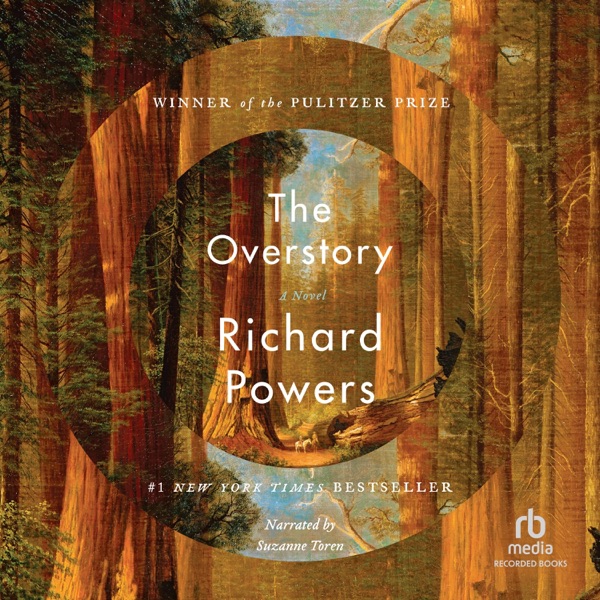


“This book is preachy.” “Trees can’t carry a 700-page novel.” I heard these warnings before I started The Overstory, and honestly? Consider this your spoiler-free guide to the Overstory audiobook. I get why people say them. Richard Powers has written something genuinely ambitious—a sweeping narrative woven around environmental collapse that could easily topple into sermonizing. But here’s the thing: the book doesn’t preach. It sprawls. It hums. It does something far more dangerous than lecture you about climate change: it makes you feel the urgency and wonder of a vast network of roots and branches, and you can’t unhear it.
Nine Lives Rooted in Witness
Powers stitches together nine interlocking stories—each character becomes obsessed with trees in their own way, their own moment. An art historian discovers the radical potential of Hokusai’s paintings. A mycologist traces the neural networks beneath the forest floor. A widowed ex-marine finds a mission guarding old growth. What could have been heavy-handed becomes something else entirely: a collaborative witness to something vast we’re destroying. The audiobook, narrated beautifully by Suzanne Toren across 22 hours and 58 minutes, captures that sprawl without losing the threads. Each voice—each testimony—settles into you like sediment.
This isn’t a book with a villain or a tidy moral. It’s a book about waking up. The characters don’t convert to tree-ness in some corny way; they simply can’t unsee once they’ve learned to look. That unsettling recognition is the real freight of the novel, and Toren’s restrained, attentive narration lets it land quietly. You finish chapters feeling less lectured and more implicated—which is the honest work of serious fiction.
Get the The Overstory Audiobook on AmazonListen on Audible · also in Kindle & printComplexity That Earns Its Length
Yes, it’s sprawling. Yes, the pacing sometimes seems to drift. But Powers isn’t building a thriller here; he’s building an ecosystem. Plot isn’t the skeleton—connection is. The novel moves between time periods, between scientific diagrams and intimate family moments, between failure and grace. That structural complexity could fall apart in print; in audio, where Toren’s voice holds the center, it feels organic. You’re not fighting the length; you’re suspended in it, the way you’d sit in a forest and lose track of hours.
If you’ve listened to something like Cloud Cuckoo Land, you know what it’s like when a novel refuses to be simple. This has that same refusal—that same insistence that the world is knotted and layered and worth your full attention. Powers respects your intelligence enough not to hammer home his points. The trees are doing their own work.
Why This Matters Now
I mention the year only because it’s unavoidable: this book was written before the climate crisis became unavoidable dinner-table talk, yet it reads like a prophecy. Powers didn’t need to shriek; he just needed to show you what we were losing. The Overstory isn’t activism in audio form—it’s something more durable. It’s the kind of book that reshapes how you see a forest, how you think about roots, how you understand your own complicity and small power.
Readers who loved the atmospheric depth of Where the Crawdads Sing or the ambitious scope of Demon Copperhead will find something equally singular here: a novel that trusts you to sit with ambiguity, to absorb a world bigger than plot. Get the The Overstory Audiobook on AmazonListen on Audible · also in Kindle & print
| Author | Richard Powers |
|---|---|
| Narrator | Suzanne Toren |
| Length | 22 hours 58 minutes |