
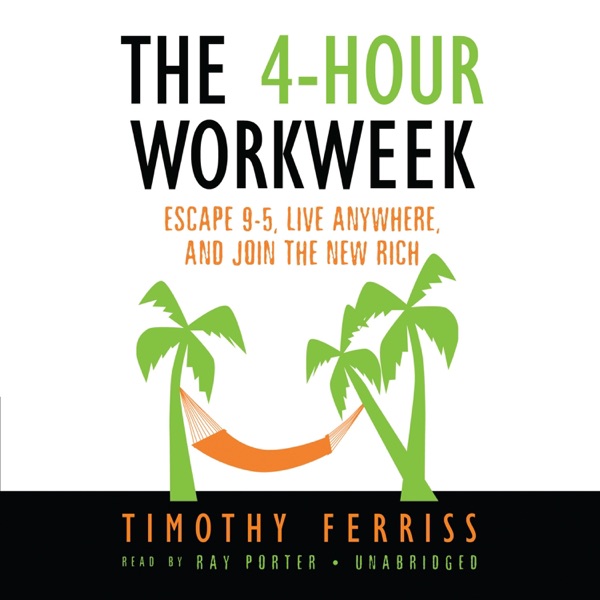


Confession: I Came In Ready to Dismiss This
Let me be honest — when I settled in to listen to The 4-Hour Workweek, I was bracing for the kind of book that treats entrepreneurship like a crypto seminar. Here’s what the 4-Hour Workweek audiobook is really like. You know the tone: breathless, maximalist, “10x your output by doing THIS one weird trick.” I’ve learned to be skeptical of anyone promising escape velocity from traditional work via a catchy title. But Timothy Ferriss surprised me. This isn’t a motivational pep talk dressed up as a business book. It’s a methodical argument about *which* priorities matter, and it’s genuinely provocative.
The premise isn’t actually “work four hours and retire.” It’s about automating or eliminating the tasks that don’t drive your life forward, then structuring the remaining time around what you actually want. That’s a different beast entirely—and Ray Porter’s narration captures the book’s conversational, detail-oriented tone perfectly across the full 8 hours and 20 minutes.
DEAL and the Radical Idea That You’re Probably Working On the Wrong Things
Ferriss structures his approach around DEAL: Definition, Elimination, Automation, and Liberation. What’s sharp about this framework is that it doesn’t romanticize hustle at all. In fact, it’s the opposite—it asks you to be ruthless about what you’re actually doing. Are you reading email all day because it matters, or because you haven’t defined what actually matters? Are you in meetings because they’re necessary, or because you’ve never tested what happens if you stop attending them?
The elimination chapter alone is worth the listen. Ferriss walks through low-information diets and the actual data on how much time we spend on things that produce zero measurable return. Deep Work handles focus as a skill; this book handles it as a consequence of honest priority-setting. It’s refreshing. The examples feel lived-in—his own business, his experiment with limiting email checks, his test-and-measure mindset. Porter reads these anecdotes without overselling them, which makes them land harder.
Get the The 4-Hour Workweek Audiobook on AmazonListen on Audible · also in Kindle & printThe Automation Chapters Hold Up (Mostly) Despite Their Age
Here’s where I’ll be blunt: The 4-Hour Workweek was published in 2007, and the specific tactics for outsourcing and automation have aged. Virtual assistants in Manila? The internet has moved on. Ferriss himself updated this book in 2009 and again in 2012, but certain case studies and reference points feel dated. Porter’s steady voice doesn’t hide this—it actually helps, because the read stays grounded and the *principles* emerge more clearly than the outdated scaffolding.
That said, the core idea—that you can systematize and delegate the routine mechanical work—is more true now than it was in 2007. The tools have changed, not the logic. Cloud infrastructure, API-based workflows, AI-assisted admin: these all do what Ferriss was describing, just faster. The audiobook doesn’t pretend the specific examples are current, and that intellectual honesty matters to me as a listener.
The Liberation section—about geo-arbitrage and building a location-independent lifestyle—does creak a bit in 2026, when digital nomadism is no longer novel and visa regulations have tightened in many countries. Ferriss acknowledges this won’t work for everyone, but the audiobook doesn’t significantly update his optimism. That’s a fair critique of the material itself, not Porter’s narration.
Get the The 4-Hour Workweek Audiobook on AmazonListen on Audible · also in Kindle & print| Author | Timothy Ferriss |
|---|---|
| Narrator | Ray Porter |
| Length | 8 hours 20 minutes |
When the Argument Actually Wins You Over
What stuck with me, though, is Ferriss’s refusal to conflate productivity with virtue. He’s not saying “grind harder.” He’s saying “be intentional about what you’re grinding for, and then stop grinding the rest.” That’s rare in business audiobooks, where the default move is to motivate you into a faster treadmill. The 4-Hour Workweek is actually asking you to step off the treadmill and build a different one, smaller and slower but pointed at something you care about. Rich Dad Poor Dad questions the conventional path to money; this one questions the conventional path to a schedule. They’re cousins.
Porter’s performance—steady, conversational, never patronizing—suits that argument. He doesn’t oversell the promise. He reads it like a friend who’s genuinely trying to walk you through something useful, not a motivational speaker pumping you up. That restraint is exactly what this book needs.
FAQ
Is this book mainly about starting a business? No—it’s for anyone on a salary or in a job that eats their time. Ferriss spends more time on elimination and automation (which apply anywhere) than on starting a venture. Many of the principles work for agency roles, corporate jobs, even shift work.
Should I skip the older examples and just get the framework? Not entirely. The examples show *how* to test hypotheses, which is Ferriss’s real gift. The specifics may be outdated, but the method—measure, test, measure again—transfers perfectly to 2026.
Listen Next
- Deep Work: Rules for Focused Success in a Distracted World by Cal Newport — complements this perfectly; one tells you *what* to focus on, the other tells you *how* to focus
- Rich Dad Poor Dad by Robert Kiyosaki — another contrarian take on conventional wisdom, this time about money instead of time
- The 12-Hour Workweek by Ryan Deiss — a more recent take on the same philosophy, with updated examples
The 4-Hour Workweek remains worth the listen because it’s not really a productivity book—it’s a permission slip to stop doing things you don’t want to do. Ray Porter reads it with just enough skepticism to keep you honest, which is exactly what a book like this needs. Go in cynical. You might leave with a clearer calendar.