
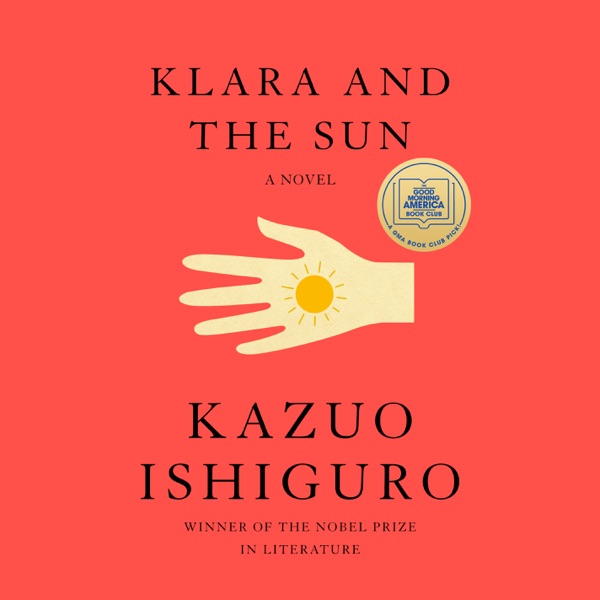


The sun moves, and Klara moves with it. So let’s get into the Klara and the Sun audiobook.
From the window of a store on a busy American avenue, an Artificial Friend watches solar trajectories across glass and pavement—a detail so precise, so quietly luminous, that it yanked me into Kazuo Ishiguro’s meditation on consciousness, connection, and what it means to witness a life from the outside. Klara and the Sun is deceptively slim and serene on the surface. Underneath runs something far more unsettling and tender than the premise suggests.
Klara’s Perspective: Clarity Without Cynicism
Most AI-character stories stumble by either making the machine coldly logical or clumsily anthropomorphizing it. Ishiguro avoids both traps. Klara narrates in first person, observing the world with genuine curiosity and a kind of steadfast devotion that isn’t programmed—or if it is, the distinction hardly matters anymore. She learns about humans the way a child does, asking direct questions, noticing contradictions, and forming conclusions that are sometimes right, sometimes painfully off-base.
What struck me most: Klara doesn’t judge. She accepts people as they are—a mother’s ambitions, a father’s doubts, a teenager’s loneliness—and tries to help in the only ways she knows how. There’s no smugness to her perspective, no suggestion that her artificial mind is superior. If anything, she’s humble about her own blindspots, even when those blindspots are profound.
Get the Klara and the Sun Audiobook on AmazonListen on Audible · also in Kindle & printA Story Built on What’s Left Unsaid
The plot centers on Klara’s relationship with Josie, the teenage girl she’s purchased to keep company, and the fracturing dynamics of Josie’s parents. But this isn’t a plot-driven novel—it’s psychological, layered, occasionally elliptical. Ishiguro trusts readers (and listeners) to sit with ambiguity. He doesn’t spell out what’s “really” happening to Josie, or whether Klara’s interpretation of events is accurate, or even whether her later quest for intervention will succeed. Some people find this frustrating. I found it deeply moving.
The restraint is the point. By withholding neat answers, Ishiguro forces us to wrestle with Klara’s dilemmas the way she wrestles with them—incomplete information, partial understanding, hope that might be misplaced. It’s almost a mirror of real parenting, real friendship: you never fully know what’s happening, you act on imperfect knowledge, and you have to live with uncertainty.
Sura Siu’s Narration: A Voice That Disappears
Sura Siu’s performance across the audiobook’s 10 hours and 16 minutes is a masterclass in restraint. She voices Klara with a kind of warm neutrality—present, attentive, but never saccharine. Siu doesn’t oversell Klara’s synthetic nature; instead, she lets the language do that work. When Klara expresses confusion or concern, Siu’s tone carries genuine puzzlement rather than mechanical uncertainty.
The supporting characters are handled with equal care—Josie’s mother is anxious without being caricatured, Josie herself sounds appropriately isolated and guarded, and the various adults Klara encounters each have distinct cadences. Siu never draws attention to herself; the story simply flows through her voice, making the full runtime feel shorter than it is.
| Author | Kazuo Ishiguro |
|---|---|
| Narrator | Sura Siu |
| Length | 10 hours 16 minutes |
Is This Book for You?
If you loved Ishiguro’s earlier work—Never Let Me Go especially—you’ll recognize his fingerprints all over this. The same gentle melancholy, the same interest in memory and mortality, the same refusal to hand you easy catharsis. Klara and the Sun isn’t a thriller or a puzzle-box. It’s contemplative, sometimes slow, and deeply humane in ways that don’t announce themselves.
Get the Klara and the Sun Audiobook on AmazonListen on Audible · also in Kindle & printFAQ:
- Do I need to have read Ishiguro before? No, but if you’ve struggled with his pacing in the past, this won’t change your mind. This is Ishiguro being Ishiguro.
- Is there a big twist? Not in the plot-turn sense. The emotional and philosophical tensions resolve more through understanding than revelation—which is far more powerful, if you’re open to it.
The Recommendation:
Press play if you’re searching for a character you’ll think about long after the credits roll. Press play if you want to sit inside someone else’s consciousness—especially someone whose consciousness isn’t quite human, which somehow makes it feel more human. Klara observing the sun from her store window became, for me, a meditation on attention itself. How we pay it. Whom we give it to. What happens when a being—artificial or otherwise—offers their full, undivided attention to another person’s life.
If that sounds like a book worth ten hours, it absolutely is. For another story about consciousness and connection, try Tomorrow, and Tomorrow, and Tomorrow, which explores human creativity and intimacy through a different lens. Both are quietly devastating in their own ways.