
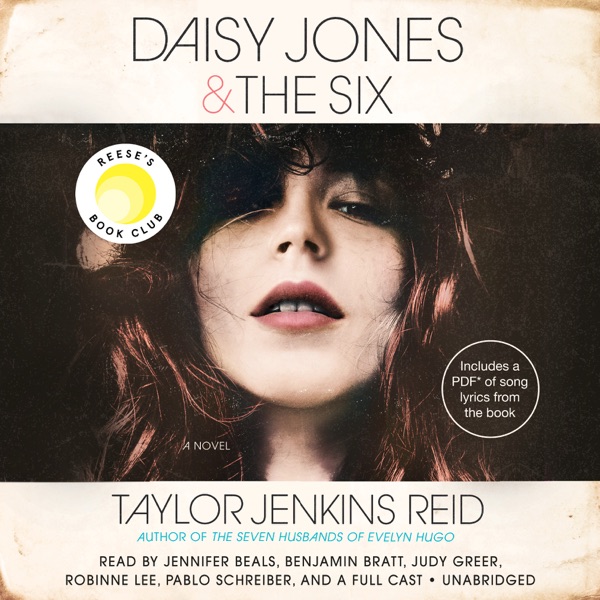


If you’ve only read Daisy Jones & the Six in print, you’ve experienced the novel as a screenplay—all dialogue and stage directions, a literary blueprint waiting for actors. The audiobook, though, is where this book lives. With twenty-one narrators lending their voices to the band members, producers, ex-lovers, and hangers-on in Taylor Jenkins Reid’s oral history, the full-cast recording transforms page into presence in a way that feels less like listening and more like overhearing a documentary being recorded in real time.
The genius of Reid’s structure—a series of interview transcripts spanning decades—was always built for audio. On the page, you work harder to differentiate voices in your head; you’re constantly anchoring yourself to who’s speaking. But when Jennifer Beals inhabits Daisy, when Pablo Schreiber becomes Billy Dunne’s weathered drawl, when Benjamin Bratt channels Graham’s controlled intensity, the story stops being literary and becomes immediate. You’re not reading a screenplay anymore. You’re listening to something that sounds like a true-crime podcast married to a rockumentary, except the crime is artistic ambition and the rock is the kind that changes lives.
The Format Does Heavy Lifting
What struck me most—and what I think the audiobook captures better than any print edition can—is the texture of memory. Each narrator carries their own angle on the band’s rise and spectacular combustion. Some are nostalgic. Some are still defensive. Some are trying, years later, to make sense of what happened. When Judy Greer moves through Karen Sirko’s interviews, the vocal performance carries the weight of her character’s regret and survival. It’s not just words; it’s the sound of someone reflecting on their own complicity.
The production by Random House Audio treats the ensemble like a real documentary team, with room noise and the sense that these people are sitting down at different points in time to remember 1975 through 1984. That framing device—the invisible interviewer—means the narrators’ voices become your primary window into who these characters are, were, and have become. There’s no prose to hide behind, no description to ease you in. It’s all presence.
Get the Daisy Jones & the Six Audiobook on AmazonListen on Audible · also in Kindle & printThe band itself is the heart: Billy and Graham Dunne, brothers at odds over creative control; Camila, Billy’s wife, trying to hold the family together; Daisy, the self-taught disaster who writes a hit by accident and then spends the rest of her life reckoning with what it means to be wanted. But Reid’s design also gives weight to the people on the periphery—the manager, the producer, the bandmates, the ex-girlfriends—and the audiobook’s ensemble cast means no voice ever feels peripheral. Even a single-scene character gets a narrator who commits, who makes that moment count.
A Love Letter to How We Remember
Listening to this book made me think about how flawed and generous memory is. Everyone agrees on the basic timeline—the band formed, they made an album, they burned out—but the emotional truth of those events shifts depending on who’s talking. Billy remembers ambition; Camila remembers sacrifice; Daisy remembers freedom, then entrapment, then a strange kind of peace. The audiobook format doesn’t resolve these contradictions. Instead, it lets them breathe, which is exactly what a story about how myths get built should do.
If you’ve ever felt moved by narrative non-fiction—the kind where personal essays about the same event reveal how differently we all lived through it—this audiobook will hit you hard. It has the authenticity of memoir without asking you to trust a single narrator’s objectivity. Reid’s choices about structure matter more here than in print, where you can skim or skip. In audio, you’re committed. You’re living through the band’s timeline at someone else’s pace, hearing people’s contradictions and heartbreak in real time.
This reminded me, in spirit, of the emotional depth in The Seven Year Slip, though that book works very differently. Both, though, understand that audio can carry the weight of interiority in ways that even strong prose sometimes can’t match.
Get the Daisy Jones & the Six Audiobook on AmazonListen on Audible · also in Kindle & printRuntime and Reality Check
At nine hours and three minutes, this is a substantial commitment, but the pacing never drags. The interview structure means scenes are naturally varied—one character’s recollection, then another’s perspective, then a moment of silence as you sit with the contradiction. It’s novelistic in ambition but episodic in rhythm, which makes for addictive listening. I burned through this in a handful of days, finding myself reaching for it in pockets of time I didn’t know I had.
The full ensemble cast—which includes January LaVoy, Robinne Lee, Julia Whelan, Jonathan Davis, and many others—means each voice gets its own texture and cadence. There’s no auditory exhaustion from listening to the same narrator for nine hours. Instead, there’s the pleasure of these voices in conversation, sometimes directly contradicting each other, sometimes building on what someone else said in a way that deepens the whole picture.
For readers who connected with Reid’s exploration of creative partnership and artistic sacrifice in A Gentleman in Moscow (where the containment is so different but the emotional stakes just as real), Daisy Jones offers a similar generosity of spirit paired with unflinching honesty about what ambition costs.
The Verdict
This is one of those rare cases where the audiobook genuinely surpasses the print edition—not because the writing isn’t good (it is), but because audio was what the form was always asking for. Reid designed a novel that needed voices, and the production understood that need. If you listen to this one, you won’t just hear a story. You’ll hear a band, disagree with them, mourn them, and walk away understanding why myths persist and why the people who create them often pay the highest price.
Daisy Jones & the Six belongs in the ears of anyone who’s loved an album, questioned whether art is worth its cost, or wondered what you’d sacrifice if someone handed you a dream and said, “This is yours now.” The audiobook doesn’t just tell that story. It performs it.
| Author | Taylor Jenkins Reid |
|---|---|
| Narrator | Full ensemble cast (21 narrators): Jennifer Beals, Pablo Schreiber, Benjamin Bratt, Judy Greer, and others |
| Length | 9 hours 3 minutes |