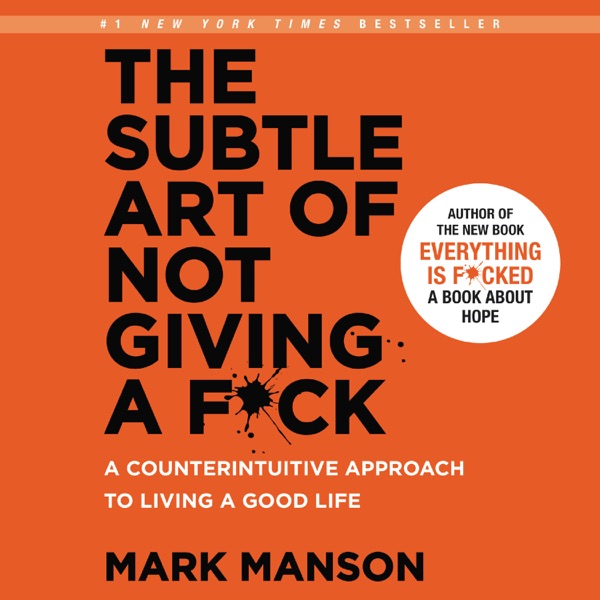


You’re sitting in a Buddhist monastery in Japan. That is the setup; now the Subtle Art of Not Giving a F*ck audiobook itself. The floor is cold. There’s nowhere to go, nothing to do, and Mark Manson is about to tell you why that’s exactly when his entire philosophy came into focus. He describes being there—stone walls, morning bells, the suffocating reality of actually being present with his own thoughts—and then the realization hits: he’s been taught his whole life to care about the “right” things in the wrong way. That opening moment, narrated with Roger Wayne’s conversational ease, sets the entire tone for The Subtle Art of Not Giving a F*ck, and you immediately understand this won’t be another motivational platitude wrapped in a self-help bow.
Mark Manson’s counterintuitive approach to living well has become one of the most beloved modern self-help books for a reason. It’s irreverent, honest, and built on a genuinely useful argument: we’ve been sold a lie about positivity, success, and caring. Instead, Manson argues, we should be ruthlessly selective about what we give our time and energy to. The audio production, narrated by Roger Wayne over 5 hours and 17 minutes, is where this particular version truly shines. Wayne’s performance is crucial here.
Why the Narrator Matters for Manson’s Tone
This book lives and dies by its voice. Manson’s writing is deliberately casual, sarcastic, and full of profanity—not for shock value, but because it’s how he actually thinks about these problems.
| Author | Mark Manson |
|---|---|
| Narrator | Roger Wayne |
| Length | 5 hours 17 minutes |
The arguments build methodically. Manson starts with brutal honesty about how hope, positivity, and self-help culture itself can become self-defeating. Then he moves into the core framework: choosing what matters, defining your values, accepting your limitations. Get the The Subtle Art of Not Giving a F*ck Audiobook on AmazonListen on Audible · also in Kindle & print Each chapter feels like a conversation rather than a lecture, and in audio form, that conversation carries real weight.
Where the Logic Holds (and Where It Strains)
The book’s strongest sections are those grounded in philosophy and psychology. Manson’s argument about values—that we should choose them consciously rather than inherit them—is genuinely useful. His discussion of entitlement and how it poisons relationships has teeth. The chapters on failure and rejection reframe these as essential data, not moral failures. These ideas work because they’re not just motivational; they come with reasoning, examples, and acknowledgment of their own limits.
The weaker sections are where Manson tries too hard to be transgressive. Some of his provocations about hope or ambition feel deliberately contrary for effect rather than truth-telling. And his relationship advice, while practical, occasionally lapses into generalizations that don’t apply equally to everyone’s circumstances. The audiobook format doesn’t smooth these moments out—if anything, hearing them performed underlines when Manson’s being clever versus when he’s being wise. Still, he earns most of his irreverence.
Who This Lands With (and Why It Might Miss for You)
If you’ve felt exhausted by the relentless positivity of mainstream self-help—the six-figure-earning-from-your-laptop fantasies, the gratitude-journal culture, the “you just need to believe harder” crowd—this book is a relief. Manson gives you permission to not chase every opportunity, to prioritize ruthlessly, to accept that you can’t optimize every aspect of your life. For anyone burned out on aspiration, this is quietly radical. If you’re at a crossroads about work, identity, or what actually matters to you, the audiobook version rewards close listening. Atomic Habits might teach you how to build; Manson teaches you why you should be selective about what you build.
Get the The Subtle Art of Not Giving a F*ck Audiobook on AmazonListen on Audible · also in Kindle & print The book’s limitations are real: it’s written largely from a position of relative privilege, and some of Manson’s examples assume a baseline of resources. His framework works best if you already have choices. But even with those caveats, the core argument—that your time and energy are finite and deserve protection—holds. And Roger Wayne’s narration makes the messier, more vulnerable parts of Manson’s philosophy land harder than they might on the page.
The Audio Experience and Real Talk About the Message
The 5-hour-17-minute runtime makes this dense without being overwhelming—perfect for listeners who want substance without a semester’s worth of commitment. Wayne’s pacing varies intelligently; he slows for the more philosophical passages and keeps momentum through the storytelling sections. You’re never waiting for the payoff.
This isn’t a book for everyone, and Manson knows it. He’s deliberately written something that will bother some readers and deeply resonate with others. But if you’re tired of being told what you should care about, and you want to hear an honest argument about what actually matters, this audiobook is worth the 5+ hours. Mindset explores growth; this book explores direction—and in an age of infinite options and constant optimization, that’s rarer and more useful than it might sound.
Narrator: Roger Wayne | Length: 5 hours 17 minutes | Best for: Anyone burned out on self-help culture who wants permission to care strategically
What to Listen to Next
- Atomic Habits by James Clear — How to build systems that actually stick
- Can’t Hurt Me by David Goggins — The extreme opposite: Goggins on pushing past limits
- The Power of Now by Eckhart Tolle — Eastern philosophy on presence and meaning
- Mindset by Carol Dweck — Growth vs. fixed thinking frameworks