
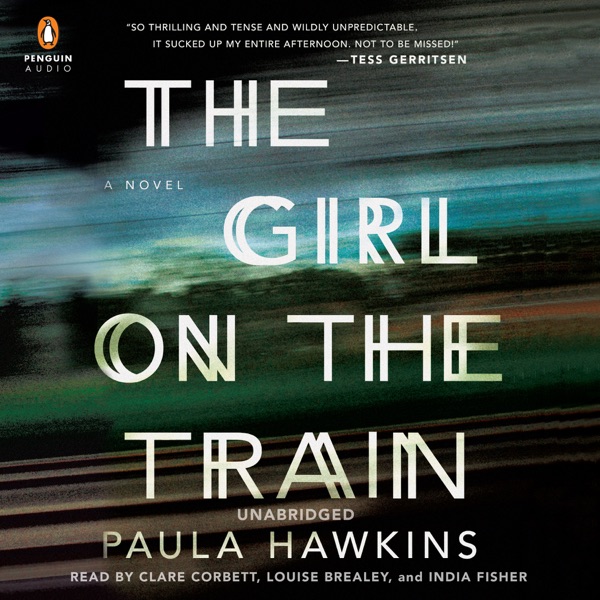


Press play and the first thing that gets you is Rachel’s voice. Consider this your spoiler-free guide to the Girl on the Train audiobook. Clare Corbett gives her this slightly frayed, over-explaining quality, the sound of a woman who has already lost the thread of her own morning and is talking a little too much to cover it. It is a brave choice, because Rachel is not always likeable and Corbett refuses to smooth her out. You hear the wine before it is ever mentioned. That is the whole trick of this audiobook working, and it works.
Three women narrating, and you can tell them apart with your eyes shut
Paula Hawkins built the novel out of three alternating points of view, and the production hands each woman her own narrator, which is exactly the right call. Corbett is Rachel, the commuter who watches one house from the 8:04 and builds a whole fantasy about the couple who live there. India Fisher voices Megan, the woman in that house, cooler and more restless. Louise Brealey takes Anna, brittle and defensive in a way that sneaks up on you. On the page the timeline jumps around and readers sometimes complain they got lost. On audio the voices do the signposting for you, and I never once had to rewind to check whose chapter I was in.
What I did not expect was how physical the performances feel. Fisher in particular plays Megan like someone pacing a room she is tired of, and Brealey lets Anna’s politeness crack in tiny, satisfying ways. The full run is 10 hours and 58 minutes, and the trio shared a 2016 Audie Award for Audiobook of the Year, which for once feels earned rather than ceremonial.
If you want the format specifics before you commit a listen, here they are.
| Author | Paula Hawkins |
|---|---|
| Narrator | Clare Corbett, India Fisher & Louise Brealey |
| Length | 10 hours 58 minutes |
What the story is actually doing
Rachel takes the same train every day and passes the same back gardens. She has decided that one couple she can see from the window are perfect, and she names them, and she narrates their lives to herself. Then the woman she has been watching goes missing, and Rachel is fairly sure she saw something the night it happened, except Rachel was drunk, and Rachel’s memory is a broken instrument she cannot trust. That is the engine of the book. You are trapped inside the head of a narrator who genuinely does not know what she witnessed, and Hawkins makes you doubt her right along with her.
I will stay well clear of spoilers, but I will say the pleasure here is not a flashy twist so much as a slow tightening. The narrators are essential to that. A weaker performance would let the middle sag, and this one does not.
Get the The Girl on the Train Audiobook on AmazonListen on Audible · also in Kindle & printA quick word before you press play
Content notes for listeners who like a heads-up: this one deals frankly with alcohol addiction, domestic abuse and emotional manipulation, infertility and pregnancy loss, and there is a death at the centre of the plot. None of it is gratuitous, but audio makes hard material land harder because a good narrator will not let you skim. If any of that is a tender spot right now, go in knowing.
What to cue up next
If Rachel’s unreliable narration is your particular drug, these three make a natural run:
- Gone Girl by Gillian Flynn, the obvious companion, with its own dual-narrator structure and a marriage you should not trust for a second.
- The Woman in Cabin 10 by Ruth Ware, for another anxious witness convinced she saw a crime nobody believes happened.
- I Let You Go by Clare Mackintosh, if you want the slow tightening and a gut-punch of a reveal done properly on audio.
For my money this is one of the audiobooks I hand to people who say they cannot get into audio, because the three voices do so much of the work that you forget you are listening rather than reading. Rachel is frustrating and messy and human, and Corbett commits to all of it. Nearly eleven hours went past faster than my actual commute ever does.
Get the The Girl on the Train Audiobook on AmazonListen on Audible · also in Kindle & printTwo quick things I keep wondering:
- Did splitting the three women across three narrators make the timeline click for you the way it did for me?
- Is Rachel a narrator you rooted for, or one you just endured to get to the answer?