
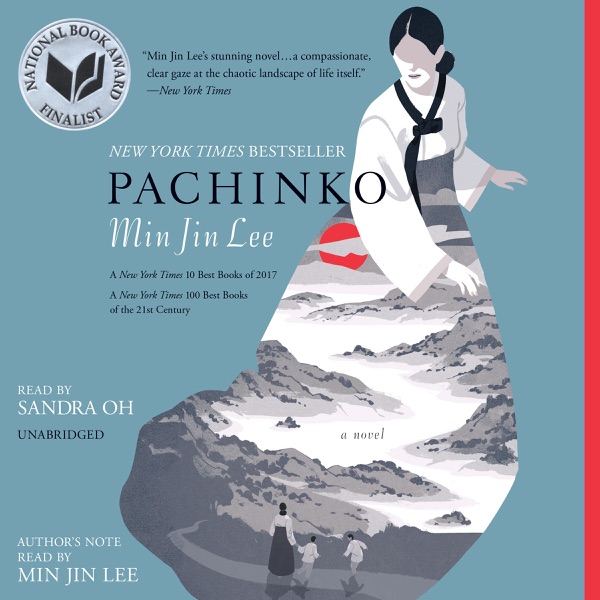


“History has failed us, but no matter.” Eight words start this novel, and a week after finishing the audiobook I am still carrying them around like a stone in my coat pocket. A few spoiler-free thoughts on the Pachinko audiobook, then. That single sentence is doing something sneaky: it sounds like surrender and turns out to be defiance. Min Jin Lee spends the next four generations proving the second half of it, and by the end I understood why she opened with a shrug instead of a battle cry.
This is a big, patient book about a Korean family living in Japan across most of the twentieth century, and I want to talk about why it works so beautifully in your ears rather than on the page.
Sunja is not the heroine you brace yourself for
When a saga opens on a teenage girl in a boarding house on a small Korean island, you think you know the shape of her story. You don’t. Sunja, a cook’s daughter in Yeongdo, is practical, quiet, and almost stubbornly ordinary, and that ordinariness is the whole engine of the novel. She does not make speeches. She makes rice, and kimchi, and decisions that ripple for eighty years. I found myself leaning in hardest during the smallest scenes, a pregnancy she has to reckon with, a marriage offered by a gentle, sickly minister, a train to Osaka toward relatives she has never met. Lee trusts that a woman weighing sugar or folding laundry can hold as much tension as any courtroom, and she is right.
If you love multigenerational family novels where the women carry the weight quietly, this sits on the same shelf as Homegoing by Yaa Gyasi, another book that lets ordinary lives testify to enormous history without ever lecturing you.
The word “pachinko” is doing far more work than the title admits
For a long stretch I wondered why the book was named after a noisy Japanese gambling game. Then it clicked. Pachinko parlors were one of the few businesses open to Koreans shut out of respectable work in Japan, and the game itself, all rigged pins and the illusion of control, becomes the family’s private metaphor. You drop your little ball in and you can nudge it, barely, but the board is built to defeat you. Watching these characters push their steel balls uphill, generation after generation, being told they are foreigners in the only country they have ever known, is quietly devastating. Lee never underlines it. She just lets the machines rattle in the background until you notice.
Get the Pachinko Audiobook on AmazonListen on Audible · also in Kindle & printAllison Hiroto reads this the way a relative would tell it
Narration can make or break a book this sprawling, and Allison Hiroto is the reason I kept pressing on through the long Osaka years. Across 18 hours and 16 minutes she keeps a huge cast legible, Sunja, her sons, the men who orbit them, the neighbors and in-laws, without ever tipping into caricature. Her Korean and Japanese pronunciation is unforced, which matters enormously in a story where language itself marks who belongs and who is merely tolerated. What I loved most was her restraint. In the moments that could have been milked for tears, she pulls back and lets the plain words land, and that steadiness is exactly the register this book wants. It feels less like a performance and more like an aunt who has decided, finally, to tell you the truth about the family.
| Author | Min Jin Lee |
|---|---|
| Narrator | Allison Hiroto |
| Length | 18 hours and 16 minutes |
It rewards the kind of patience most audiobooks don’t ask for
I will be honest that this is not a listen you dip into for ten minutes on a commute. The timeline moves in decades, characters you have grown to love recede as their children step forward, and there is grief that arrives without much warning. But that patience pays. Somewhere around the halfway mark I stopped waiting for a plot to “kick in” and realized the accumulation of ordinary days was the plot, and it had already gotten its hooks into me. If you enjoyed the slow, room-by-room pleasure of A Gentleman in Moscow by Amor Towles, or the way The Help by Kathryn Stockett hands its history to you through kitchens and quiet loyalties, you already have the muscles this book asks you to use.
Why I keep recommending it to people who “don’t read historical fiction”
What surprised me is how contemporary it feels. Strip away the dates and Pachinko is about belonging, about the exhausting work of being told your whole life that you are not quite from anywhere, and about the private dignity people build when the world refuses to grant them a public one. It is spoiler-free of me to say that the ending offers no tidy triumph, and I mean that as praise. Lee resists the redemptive bow. She leaves you instead with something rarer, a family that endured, which in the arithmetic of this book turns out to be its own kind of victory. That is what the opening line was promising all along.
If you have been circling this one, the audiobook is the version I would put in your hands. Hiroto’s reading is the closest thing to hearing it told across a kitchen table.
Get the Pachinko Audiobook on AmazonListen on Audible · also in Kindle & printThree things I keep wondering about
- Sunja is offered a way out early on and refuses it. Would you have made the same choice, or is her stubbornness the thing that costs her family the most?
- The novel argues that surviving is itself heroic. Do you buy that, or do you want your sagas to end in something bigger than endurance?
- Did the pachinko metaphor land for you as quietly as it did for me, or did you clock it from the first parlor?