
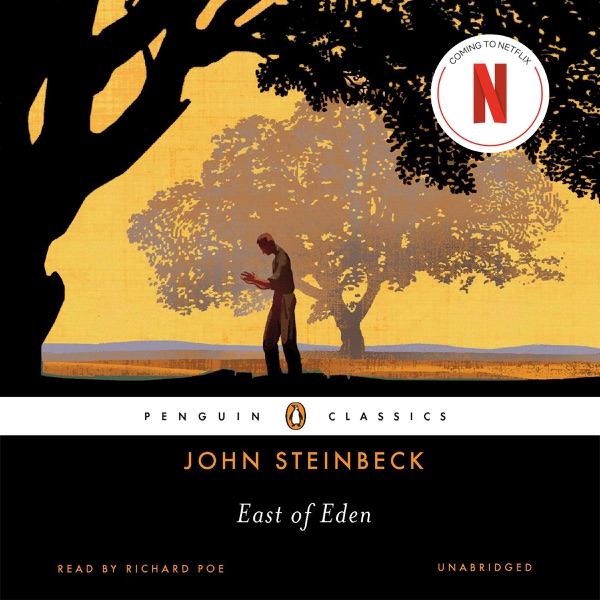


There’s a particular kind of terror that comes with opening a 1,100-page brick of American literature, and East of Eden carries it in spades. John Steinbeck’s generation-spanning Salinas Valley saga—a retelling of Cain and Abel woven through the lives of the Trask and Hamilton families across decades—is the kind of doorstopper people genuinely fear to start. And yet, I’m here to tell you that this is exactly the kind of book where audiobook format isn’t just a convenience. It’s where East of Eden finally breathes.
When you’re holding a physical copy, those 1,100 pages can feel like a commitment. When Richard Poe is guiding you through Steinbeck’s prose for 25 hours and 19 minutes, you’re not climbing a mountain. You’re being invited into someone’s living room for an extended, intimate conversation about the nature of free will, the weight of family legacy, and what it means to choose your own path.
Poe’s narration is the quiet revelation here. This is not a flashy performance—and thank goodness for that. What he does instead is something far more valuable: he creates the unmistakable sense that he understands every layer of Steinbeck’s writing. His voice carries the weathered wisdom of Sam Hamilton and the gentle uncertainty of Caleb Trask with equal conviction. When Poe shifts between Abra’s youthful idealism and the steely determination of Catherine, the transitions feel inevitable, not performed. That’s the mark of a narrator who has truly inhabited the book.
The structure of East of Eden could sink a weaker reader-narrator team. Steinbeck doesn’t write in straightforward chronology. He circles back, reflects, meditates on the meaning of a gesture or a silence. It’s a technique that can feel ponderous on the page—but in Poe’s hands, it becomes rhythmic. Those seemingly meandering passages about the Salinas Valley, the California seasons, the small moral choices that ripple across generations, don’t drag. They settle into your mind the way rain settles into soil. By the time you reach Caleb’s desperate plea for his father Adam’s blessing in the novel’s final pages, you understand why it matters. Poe has carried you through enough of these characters’ lives that you feel the weight of that rejection as deeply as Caleb does.
Get the East of Eden Audiobook on AmazonListen on Audible · also in Kindle & printLong audiobooks often ask a lot of us—hours of commuting, long drives, or quiet evenings that eventually add up. But length isn’t a flaw in East of Eden; it’s the entire point. Steinbeck was attempting something almost encyclopedic: to capture how a family’s sins and choices don’t resolve neatly, how the same mistakes repeat across generations, and how a single person can choose differently. That scope needs room to breathe. On audio, the length becomes a feature. You’re not rushing. You’re absorbing.
Poe handles the novel’s philosophical core without ever letting it overwhelm the human element at the story’s heart. Whether he’s narrating Samuel Hamilton’s wry observations about human nature, or the aching complexity of Adam Trask’s blindness to his wife’s true nature, or Timshel—that crucial untranslated Hebrew word meaning “thou mayest,” which becomes the novel’s spiritual center—Poe treats every moment with the gravity it deserves. He never winks at the audience or undercuts the earnestness. He trusts Steinbeck’s vision and lets it unfold.
For listeners who have loved The Stand or who found themselves drawn into the multi-generational scope of All the Light We Cannot See, this is essential listening. It’s the kind of book that reminds you why certain stories endure—not because they provide easy answers, but because they ask the right questions in the right way. And if you’re someone who tends to avoid the “classics” because they feel like homework, let this be your gateway. East of Eden is about ambition, desire, betrayal, and the possibility of redemption. It’s not stuffy. It’s human.
| Author | John Steinbeck |
|---|---|
| Narrator | Richard Poe |
| Length | 25 hours and 19 minutes |
The audiobook format also means you can immerse yourself in Steinbeck’s sentences without the distraction of turning pages or tracking characters across a thick book. Poe’s voice becomes the thread that guides you through decades, from the Civil War era through World War I and into the 1910s. That continuity—hearing the same narrator age alongside the characters, or shift seamlessly between young Adam and old Adam—creates a cohesion that makes the experience feel like a single, unbroken journey.
If you have the time and the patience for a book that refuses to hurry, East of Eden on audio will reward you. Poe’s narration transforms nearly 25 hours into something that feels less like a time commitment and more like a privilege. You’ll find yourself thinking about Timshel long after the final page turns—about whether you believe in the freedom to choose, and what that choice costs.
Get the East of Eden Audiobook on AmazonListen on Audible · also in Kindle & printThis is why we return to the classics. And this is why you should listen.