
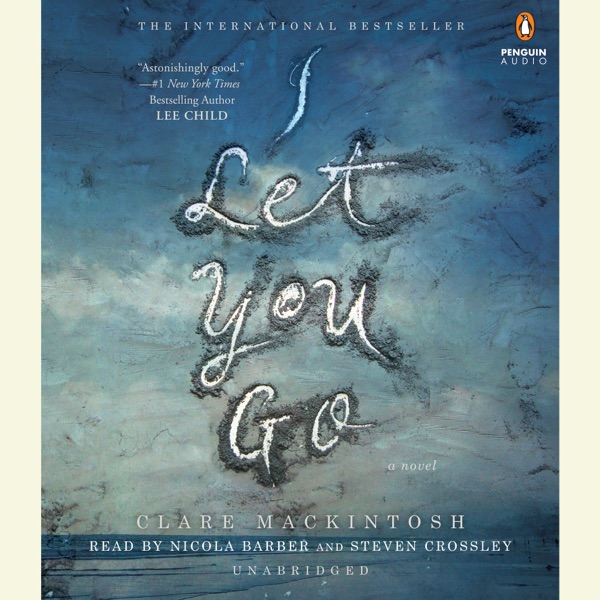


Nicola Barber does something in the first ten minutes of I Let You Go that made me stop wiping down the kitchen counter and just stand there. A few spoiler-free thoughts on the I Let You Go audiobook, then. She reads the rain-slicked school run that opens the book at an ordinary, almost cheerful clip, and then she lets one sentence drop half a step in pitch, and the whole floor gives way. Paired with Steven Crossley, whose Bristol detective sections are dry, tired, and quietly decent, this is dual narration used the way it should be: two textures that don’t just alternate chapters but argue with each other about what kind of story you’re in.
Barber carries Jenna Gray, the woman who flees to a battered cottage on the Welsh coast after a five-year-old is killed by a car that didn’t stop. Crossley handles DI Ray Stevens and the grind of a case nobody can close. For a little over twelve hours their two worlds circle, and Clare Mackintosh keeps tightening the rope so gently you don’t feel it around your wrists until it pulls.
The cottage, the guilt, and a narrator who trusts silence
What I love about Barber’s Jenna is how much she withholds. There’s a version of this performance that would sob its way through every scene on the beach at Penfach; instead she plays a woman holding herself together with both hands, flinching at kindness, translating everything into the language of someone who believes she deserves nothing. The photography subplot, the slow thaw with the locals, the dog that decides to adopt her anyway, all of it lands harder because Barber refuses to beg you for the tears. She lets you arrive at them yourself.
Crossley is the counterweight. His Ray is a good cop with a middling marriage and a junior officer, Kate, whose stubbornness keeps the file open. These procedural chapters could feel like a detour from the emotional core, but Crossley reads them with such lived-in fatigue that they become their own kind of ache. The two narrators never share a scene in any obvious way, yet by the halfway mark you feel them leaning toward the same terrible middle.
Content notes: this is a book built on the death of a child and the grief that follows, and it does not look away. There is also emotional and physical abuse handled with real weight. If either sits too close to home right now, go in gently, or come back to it another day. It will keep.
Why the audio, specifically, is the way to take this one
Mackintosh’s structure depends on what you’re allowed to assume, and audio is merciless about assumptions. On the page your eye can wander ahead; in your ears you only have the voice you’re given, in the order you’re given it. Barber and Crossley use that. I’ll say nothing about the turn this book is famous for except that I gasped in a parked car, sat through a whole song I don’t even like, and immediately wanted to start again to hear what the narrators had been doing to me the entire time. That is the mark of performances that were in on it from line one.
| Author | Clare Mackintosh |
|---|---|
| Narrator | Nicola Barber, Steven Crossley |
| Length | 12 hrs and 13 mins |
If you want the numbers before you commit: the Penguin Audio edition runs 12 hours and 13 minutes, narrated by Nicola Barber and Steven Crossley. It’s a full evening-and-a-bit of listening, and the back third moves fast enough that I lost a night to it with no regrets.
Get the I Let You Go Audiobook on AmazonListen on Audible · also in Kindle & print
What to cue up next
If I Let You Go leaves you wanting more stories that hide a knife behind the domestic, start here:
- The Girl on the Train by Paula Hawkins, for another unreliable woman whose version of events you’ll keep re-checking.
- The Last Thing He Told Me by Laura Dave, if it’s the a-life-built-on-a-secret angle that hooked you.
- The Silent Patient by Alex Michaelides, for a twist that reframes everything you thought you understood.
Any of the three make a fair follow-up, but I’d reach for the Hawkins first; it’s the closest cousin in tone. And if you haven’t grabbed Mackintosh’s yet, here it is one more time: Get the I Let You Go Audiobook on AmazonListen on Audible · also in Kindle & print
Two quick things before you go: did you clock the trick before Barber and Crossley sprang it, or did it get you clean? And which of the two narrators do you think carried the harder half of this book?