
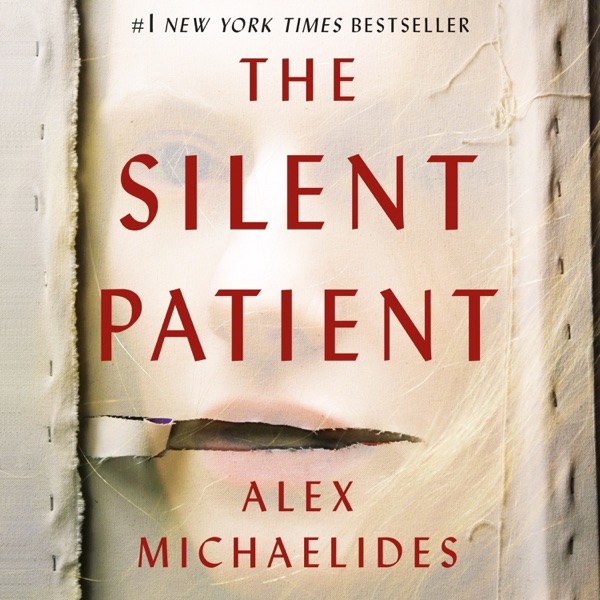


I was two stops past my own, earbuds jammed in on a late train, pretending to study the transit map so the man across the aisle wouldn’t try to talk to me. A few spoiler-free thoughts on the Silent Patient audiobook, then. Then Theo let a small, offhand detail slip about Alicia’s diary and I said “no” out loud, to nobody. I actually pulled my thumb back to the screen and rewound ten seconds, convinced I’d misheard. I hadn’t. I just wasn’t ready.
A woman who won’t say a word
The setup is almost unfairly good: Alicia Berenson, a painter, shoots her husband five times in the face and then never speaks again. Not at the trial. Not in the secure unit where she’s locked away. Theo Faber, a criminal psychotherapist who has quietly fixated on her case for years, talks his way into working with her, determined to be the one who finally gets her to speak. That’s the engine. What Michaelides does with it is the reason people won’t shut up about this book, and I’m not going to be the one who spoils it.
Why the audio does something the page can’t
Here’s the small irony I kept turning over: this is a story about a woman’s silence, and the audiobook is carried by voices. It shouldn’t work as well as it does. But splitting the narration between two performers turns Theo’s chapters and Alicia’s diary entries into genuinely separate rooms of the same house, and that structure lands harder in your ears than it ever did in my eyes when I later flipped through the print copy.
Get the The Silent Patient Audiobook on AmazonListen on Audible · also in Kindle & printTwo narrators, and the trick they pull
Jack Hawkins voices Theo with this measured, faintly clinical warmth — the sort of voice you’d trust in a consulting room, which is exactly the point and exactly the problem. Louise Brealey handles Alicia’s written entries, and she plays them with a live-wire tension that made the “silent” character feel like the loudest person in the story. Their two registers rubbing against each other is where the tension actually lives. Over eight hours and thirty-three minutes I never once lost track of who I was with, and by the end I understood why the casting mattered more than I’d assumed going in.
| Author | Alex Michaelides |
|---|---|
| Narrator | Jack Hawkins & Louise Brealey |
| Length | 8 hrs 33 mins |
The part that kept me sitting in a parked car
I finished the last stretch in my own driveway, engine off, because I refused to walk inside until it was done. If you liked the cold, unreliable dread of Gone Girl, or the way an ordinary commute curdles into menace in The Girl on the Train, you already have the right nervous system for this one. It’s tighter than both — leaner, faster, more interested in landing one clean blow than a dozen small cuts.
Is it flawless? No. A couple of the therapy-office scenes lean a little tidy, and if you’re the type who reverse-engineers thrillers for sport, you may spot a seam or two. I didn’t, because Hawkins and Brealey never gave me a quiet enough moment to try.
A few things listeners keep asking me
Is it confusing to follow with the two voices and the diary format? The opposite, honestly. The split narration makes the timeline easier to hold in your head than reading it did. You always know which thread you’re in.
Will the twist be ruined if I’ve heard people talk about it? Only if they were cruel. The reveal depends on how it’s built, not just what it is, so even a vague heads-up doesn’t defuse the ending. Go in as blind as you can manage.
Good pick if I mostly listen at 1.5x while doing chores? Yes, but I’d drop back to normal speed for the final ninety minutes. You’ll want to feel every pause where it counts.
Get the The Silent Patient Audiobook on AmazonListen on Audible · also in Kindle & print