
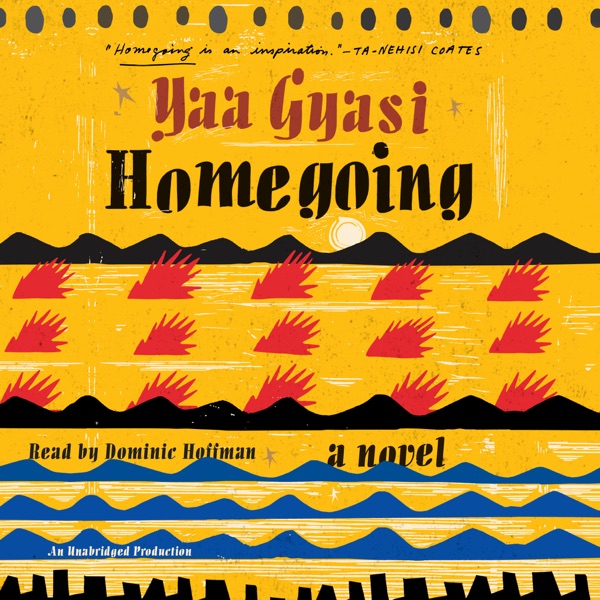


You begin with two half-sisters in eighteenth-century Ghana who never meet, and by the end you have followed their bloodlines across three hundred years and seven generations. Settle in for my take on the Homegoing audiobook. Yaa Gyasi’s Homegoing carries all of that on audio, and hearing each life spoken aloud makes the whole sweep land somewhere in your chest. It is the kind of listen that quietly reorders how you think about family.
Two sisters who never learn the other exists set three centuries in motion
The architecture here is the whole gamble. Each chapter belongs to a new descendant, alternating between Effia’s line and Esi’s, moving forward one generation at a time — eighteenth-century Ghana, the slave castles, Asante warfare, the cocoa farms, then across the water into plantation Alabama, the coal mines of Reconstruction, Harlem’s jazz clubs, twentieth-century Baltimore. You spend perhaps forty minutes with a character, fall for them, and then Gyasi hands you their child. It sounds like it should feel like whiplash. Somehow it accumulates instead. By the back third I found myself doing the math in my head, tracing which branch I was on, feeling the weight of everything that had already been lost pressing on people who have no way of knowing their own history.
Dominic Hoffman treats fourteen protagonists as fourteen separate human beings
This is a narrator’s minefield, and Dominic Hoffman walks it with real intelligence. A book that hands off its point of view every chapter could easily turn into a blur of interchangeable voices. Hoffman refuses that. His Ghanaian characters carry a cadence and warmth entirely distinct from the flatter, more guarded American descendants who come later, and he lets the accents migrate and soften across generations the way real speech actually does. He never overacts the brutality — and there is brutality here — which somehow makes it land harder. He simply reports it in a voice that trusts you to feel it. Over the full 13 hours and 11 minutes he keeps every thread legible, which in a structure this fragmented is genuinely the difference between a good audiobook and a confusing one.
If you want to know exactly what you are picking up before you commit, the essentials are here:
| Author | Yaa Gyasi |
|---|---|
| Narrator | Dominic Hoffman |
| Length | 13 hrs 11 mins |
The history never once feels like a homework assignment
What impressed me most is how lightly Gyasi wears her research. Each chapter is essentially a self-contained short story, and every one is anchored in a specific historical pressure — the British and Dutch competition for enslaved people, the convict-leasing system that re-enslaved Black men after emancipation, the Great Migration, the heroin years. But she never lectures. The history arrives through a character wanting something small and human and being denied it. Fans of the way Pachinko carries a family across borders and decades will recognize the ambition immediately; this is that same generational sweep, compressed and made even more restless. And readers who loved how The Help sat inside the daily texture of the American South will find that texture here too, though Gyasi is far less interested in comfort or resolution.
What I kept thinking about long after the last chapter faded
I want to be careful not to spoil the closing movement, because the way the two bloodlines finally rhyme is earned and quiet rather than tidy. What stayed with me is the novel’s argument about inheritance — the idea that trauma and resilience both get passed down like a family heirloom nobody chose to receive. A character late in the book talks about how history is storytelling, about who gets to hold the pen. That line reframed the entire listen for me. Gyasi is not just telling you what happened; she is showing you how a whole family loses the thread of its own origin, and what it costs them.
It is a demanding listen in the emotional sense — if you found the hardship in The Four Winds heavy, know that Homegoing asks a similar stamina of you. But it never wallows, and it moves. At just over thirteen hours it is remarkably efficient for a book covering this much ground, and I never once wanted it padded. This is one of the few audiobooks I finished and immediately wanted to start again, just to catch the echoes I missed the first time through.
Where it landed for me: this is a modern classic that the audio format actively improves, largely because Hoffman gives these voices back their sound. If you listen to be moved and to think, put this near the top of the queue.
Get the Homegoing Audiobook on AmazonListen on Audible · also in Kindle & printThree things I would genuinely love to hear from you
- Did the one-chapter-per-generation structure pull you deeper in, or did you wish you could stay longer with certain characters before Gyasi moved on?
- Which branch — Effia’s line in Ghana or Esi’s line in America — held your attention more tightly, and why do you think that was?
- If Homegoing landed for you, what other multi-generational audiobook did it send you searching for next?