
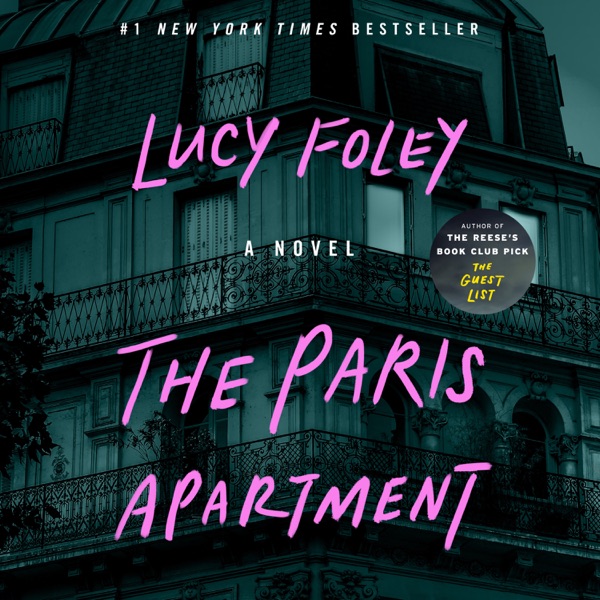


There is a particular kind of dread that only good crime fiction can bottle, and Lucy Foley bottles it again here: the feeling of standing in a beautiful room and slowly understanding that every person in it is lying to you. Consider this your spoiler-free guide to the Paris Apartment audiobook. I listened to The Paris Apartment across three grey commutes and one very long bath, and by the final hour I was doing that embarrassing thing where you sit in a parked car with the heater running because you cannot possibly turn the engine off in the middle of a chapter.
The premise fits on a postcard. Jess, broke and running from something unpleasant back in England, turns up unannounced at her half-brother Ben’s Paris apartment. Ben is not there. His phone rings out. His wine glass is still on the side, his cat is prowling the rooms, and the grand old Haussmann building around her is stuffed with neighbours who smile a beat too long. Where Ben has gone, and why nobody in the building seems remotely eager to help her find out, is the quiet motor that drives the whole story.
The building itself behaves like a character with something to hide
What struck me first, before any of the twists, was the address. Foley writes this apartment block the way other authors write a haunted house. There is a wrought-iron lift that groans between floors, a concierge tucked into a cupboard-sized lodge who sees everything and says nothing, a courtyard that swallows sound, and residents stacked above and below one another like secrets in a filing cabinet. In audio, that vertical geography does something clever to your imagination. You start picturing the whole building at once, every apartment humming with its own private version of events, and you become as nosy and paranoid as Jess herself. Paris here is not the postcard city of cafes and lamplight. It is shuttered, watchful, and expensive in a way that keeps outsiders firmly on the pavement.
A full cast turns simple eavesdropping into an art form
This is where the production earns its keep. The Paris Apartment is performed by a full cast, and the roster is worth naming: Clare Corbett, Daphne Kouma, Julia Winwood, Sope Dirisu, Sofia Zervudachi, and Charlie Anson each take a resident of the building. Because Foley tells the story through rotating points of view, that casting choice is not decoration, it is structural. Every time the perspective shifts to a new apartment, a new voice arrives with it, and you recalibrate on instinct: whose account is this, and how much of it do I believe? Corbett anchors things as Jess, all wary working-class grit, while the other performers layer in the clipped politeness and buried menace of the neighbours. The accents move between English and French without ever tipping into caricature, and the effect is that you feel genuinely surrounded, as if you have been dropped into the stairwell and can hear doors closing on either side of you.
I want to be honest that full-cast productions can go wrong. Sometimes the voices clash, or one performance is so much stronger that the others feel thin by comparison. That does not happen here. The cast feels like an ensemble that read the same book and agreed on the same tone, which is rarer than it sounds.
Get the The Paris Apartment Audiobook on AmazonListen on Audible · also in Kindle & printJess is an outsider, and the narration never lets you forget it
One of the smartest things about listening rather than reading is how the performance keeps Jess’s status as an interloper right at the front of your mind. She does not speak fluent French. She does not have money. She does not know which questions are rude and which are dangerous. Corbett plays that discomfort beautifully, a slight tightness in the voice whenever Jess is out of her depth, which in this building is roughly always. You are aligned with her completely, which means you are also flying blind alongside her, and Foley uses that partial vision to dole out information at exactly the pace that keeps you leaning forward. If you enjoyed the way Foley trapped a cast of unreliable people together in The Guest List, you will recognise the machinery, though I think the claustrophobia lands even harder here because the walls are literally closer.
At twelve hours and twenty-five minutes, the tension tightens rather than sprints
The runtime is 12 hours and 25 minutes, and I would describe the pacing as a slow tightening rather than a chase. Foley is patient. She lets you sit in the awkward dinners and the half-answered questions, and she trusts that unease is more corrosive than action. There were a couple of mid-book stretches where I wanted her to push the accelerator, and then the last quarter arrived and I forgave everything, because the payoff depends entirely on all that careful groundwork. This is a book that rewards the full listen. If you tend to bail on slow burns, know going in that the burn is the point.
| Author | Lucy Foley |
|---|---|
| Narrator | Clare Corbett, Daphne Kouma, Julia Winwood, Sope Dirisu, Sofia Zervudachi, Charlie Anson |
| Length | 12 hours 25 minutes |
The listeners I would hand this to without hesitation
If you like your thrillers atmospheric and contained, a locked-room mystery where the room happens to be an entire apartment block, this is an easy recommendation. Fans of the isolated-setting dread in The Woman in Cabin 10 will feel right at home, and anyone who loves a narrator you are not sure you can trust should also cue up None of This Is True for a similar itch. What sets The Paris Apartment apart in audio specifically is that full cast. Reading it on the page, you supply the voices yourself. Listening, you are handed six of them, each with its own agenda, and the story becomes something closer to standing in the courtyard at night with every window lit.
Get the The Paris Apartment Audiobook on AmazonListen on Audible · also in Kindle & printThree things I am still turning over
- Did hearing six different performers make you trust or distrust the neighbours more than reading their chapters silently would have?
- Jess spends the whole book as an outsider who cannot read the room; did that make her easier to root for, or more frustrating to follow?
- Foley clearly loves the trapped-together setup, so which of her books pulls it off best for you on audio?
Drop your answers in the comments. I read every one, and I am genuinely curious whether the ending hit you the way it hit me somewhere around the Peripherique in rush-hour traffic.