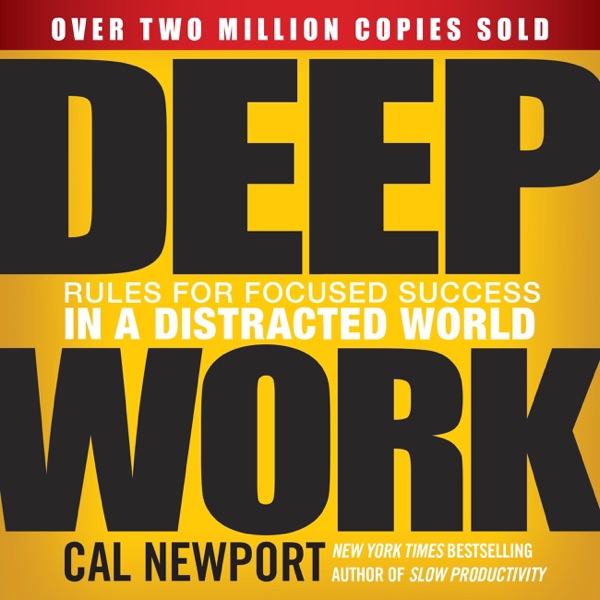


I came to the Deep Work audiobook the way most of us come to Cal Newport: mid-scroll, vaguely guilty, wondering where my afternoon went. Listening to a book about focus while I was chronically unfocused felt almost like a dare. But something clicked in the first hour, and I ended up rewinding chapters just to sit with the ideas. On audio, this one hits differently than I expected.
Get the Deep Work Audiobook on AmazonListen on Audible · also in Kindle & printWhat Deep Work is about
Newport’s core argument is simple and a little confronting: the ability to concentrate without distraction on a cognitively demanding task is becoming both rarer and more valuable at exactly the same time. He calls that ability “deep work,” and he contrasts it with the shallow, reactive busywork, email, pings, meetings about meetings, that fills most modern jobs and feels productive while producing very little of lasting worth.
From there he builds a case for treating focus as a skill you train rather than a mood you wait for. He weaves in stories of writers, academics, and executives who guard their attention fiercely, then turns practical, offering rituals and routines for carving out real concentration in a world engineered to fracture it. It’s part manifesto, part manual, and it never talks down to you.
| Author | Cal Newport |
|---|---|
| Narrator | Jeff Bottoms |
| Length | 7h 44m |
The narration: a calm voice for a noisy subject
Jeff Bottoms narrates the unabridged edition, which runs 7 hours and 44 minutes, and his steady, unhurried delivery is a quiet asset here. There’s no theatrical flourish, and honestly the material doesn’t need any; his measured pace lets Newport’s arguments land and gives you room to think alongside them. As productivity nonfiction, this is a book you’ll want to revisit, and Bottoms makes it easy to re-listen. I’ve replayed the sections on scheduling and “attention residue” more than once, and they hold up beautifully on a walk or a commute when your hands are busy but your mind is free.
Is the Deep Work audiobook worth a credit?
For me, yes, without much hesitation. At under eight hours it’s efficient, it’s genuinely useful, and it’s the rare self-improvement title that rewards a second pass. If you spend your listening time on ideas you actually want to apply, this earns its spot in your library and then keeps earning it.
Who should press play
Press play if you’re a knowledge worker, student, writer, or maker who feels scattered and suspects your best thinking is getting nibbled away by notifications. You’ll find both permission and a plan. Skip it, or at least borrow it first, if you want cozy motivational fluff or breezy anecdotes; Newport is prescriptive and a bit demanding, and that’s precisely the point.
If you like Deep Work, listen to these next
- Ego Is the Enemy by Ryan Holiday — a sharp companion on quieting the noise inside your own head so the real work can happen.
- The Daily Stoic by Ryan Holiday — bite-sized reflections that pair perfectly with a focus practice you’re trying to build day by day.
- The Laws of Human Nature by Robert Greene — a deeper, longer listen for anyone who loved thinking hard about how attention and behavior actually work.
How to listen to Deep Work
The simplest route is Audible or Amazon: start a free trial and grab it with a credit, or buy the audiobook outright to keep it forever. If you like to read and listen, it pairs naturally with the Kindle or print edition, so you can highlight Newport’s rules and revisit them long after the final chapter.
Get the Deep Work Audiobook on AmazonListen on Audible · also in Kindle & printFrequently asked questions
Who narrates the Deep Work audiobook?
Jeff Bottoms narrates the unabridged edition, and his calm, even-keeled delivery suits the book’s practical, no-nonsense tone.
How long is the Deep Work audiobook?
It runs 7 hours and 44 minutes, which makes it an easy weekend listen or a few focused commutes.
Is Deep Work good on audio if it’s a productivity book?
Yes. The ideas are clear and modular, so they translate well to listening, and the shorter runtime makes it easy to re-listen and reinforce the habits.
Do I need to read the print book too?
Not at all, the audiobook stands on its own, though many listeners like keeping the Kindle or print edition nearby to revisit Newport’s rules and routines.