

Why Do Drug Dealers Still Live With Their Moms? (And Other Questions That Actually Matter)
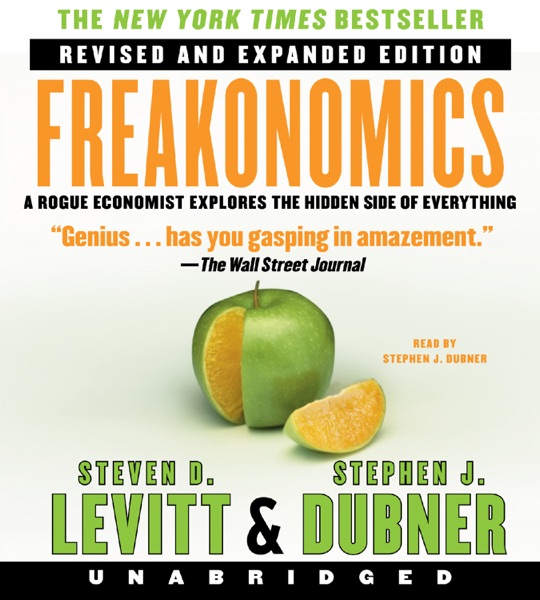
That’s the kind of question that stops you mid-commute. And it’s exactly the kind of question Steven D. Levitt and Stephen J. Dubner answer in Freakonomics—the book that taught millions of us to see the hidden economic logic beneath everyday life.
When I first heard this audiobook, narrated by Stephen J. Dubner himself, I was expecting a dry economics lecture. What I got instead was something far stranger and more delightful: a mind-bending exploration of how the rules of incentives govern everything from parenting to sumo wrestling to the motivations of drug dealers in Chicago. This is pop economics at its finest, and Dubner’s own voice brings an infectious curiosity to every chapter.
A New Way to See the World
Freakonomics isn’t a self-help book in the traditional sense. It doesn’t teach you a technique or a productivity hack. Instead, it does something more fundamental: it reframes how you think about decision-making itself. Levitt, an economist at the University of Chicago, asks unconventional questions—what do schoolteachers and sumo wrestlers have in common?—and then uses data to find answers that surprise and delight.
The audiobook unfolds like a series of connected stories. One chapter investigates why drug dealing pays so little despite its risks. Another explores whether parents really matter as much as we think. A third questions the conventional wisdom about names and success. Each story follows the same pattern: take a puzzle everyone ignores, apply economic thinking, and watch the world shift into focus.
Get the Freakonomics Audiobook on AmazonListen on Audible · also in Kindle & printDubner’s Voice Makes It Sing
What separates this audiobook from just reading the book yourself is Dubner’s narration. He’s a naturally curious storyteller—after all, he spent his career as a journalist interviewing Levitt for The New York Times before they wrote this together. That collaborative energy comes through in every chapter. His pacing is perfect: he lingers on the surprising bits, races through the setup, and lands every punchline. When he reads about the economics of drug dealing or dissects the hidden costs of raising a child, you hear genuine fascination in his voice, not the detached tone of someone reading data points.
| Author | Steven D. Levitt & Stephen J. Dubner |
|---|---|
| Narrator | Stephen J. Dubner |
| Length | 6 hours 55 minutes |
I found myself pausing the audiobook frequently to text friends about some revelation—usually something like “Did you know that your name might affect your success in school?” or “Sumo wrestlers might be cheating more than you’d think.” This is the kind of book that generates conversations, and Dubner’s delivery makes those conversations feel organic rather than forced.
Who Should Press Play
If you’re naturally curious about how the world actually works—not how we assume it works—this is for you. If you’ve ever wondered why incentives drive behavior in ways that seem illogical or counterintuitive, this audiobook will validate that instinct and give you a framework for understanding it. You don’t need an economics background. In fact, a skepticism toward conventional wisdom is more useful than any formal training.
Freakonomics pairs well with other books about understanding human behavior and decision-making. If you’ve enjoyed Atomic Habits for its data-driven approach to personal change, or Deep Work for its focus on what actually moves the needle in our lives, you’ll appreciate Levitt and Dubner’s similar commitment to following the evidence wherever it leads. And if you’re drawn to the kind of thinking in The Obstacle Is the Way—examining assumptions about obstacles and failure—you’ll find kindred thinking here.
The only caveat: this is a book about economics, even if it doesn’t feel like one. If you’re looking for a practical how-to or a self-improvement program, you’ll need to do the translation work yourself. Freakonomics won’t tell you how to be a better parent or a more effective professional. It will give you a lens for thinking about those questions differently, and it trusts you to draw your own conclusions.
Get the Freakonomics Audiobook on AmazonListen on Audible · also in Kindle & printStephen J. Dubner’s narration transforms what could have been academic curiosity into genuine entertainment. The audiobook’s real strength is that it makes economics feel like detective work—and Dubner is the perfect guide. By the time you finish, you’ll start seeing incentives lurking beneath every corner of human behavior.