
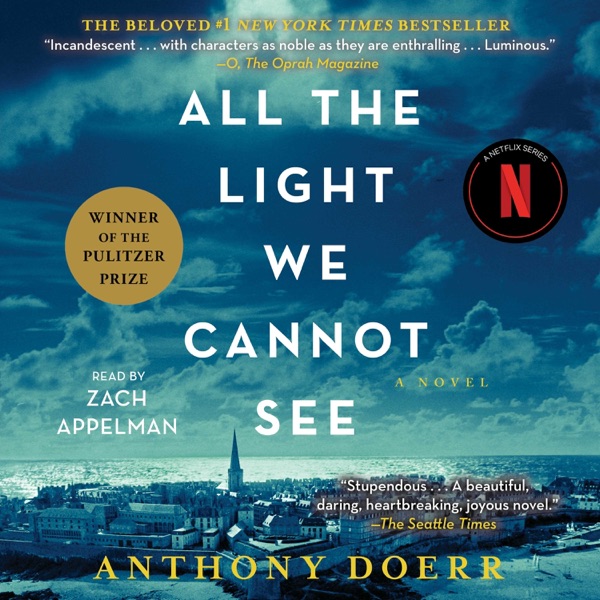


Can a novel where almost nothing happens quickly still keep you pinned to your earbuds for sixteen hours? Let me walk you through the All the Light We Cannot See audiobook. That is the strange dare Anthony Doerr sets, and after living inside this audiobook I think the answer is a stubborn yes. All the Light We Cannot See is a Pulitzer winner about a blind French girl and a radio-obsessed German boy whose paths bend slowly toward the same bombed-out seaside town, and it turns out to be one of the most patient, quietly gripping listens I have picked up all year.
A radio and a fistful of stones somehow carry the whole thing
Marie-Laure loses her sight young and learns her Paris neighborhood by tracing a wooden model her father carves for her. Werner is an orphan in a German mining town who can fix any wireless set put in front of him, a talent that hands him a ticket out and a uniform he never quite grows into. Around them Doerr threads a cursed diamond, a dying great-uncle who broadcasts science lessons into the dark, and the slow crush of occupied France. On paper it sounds like too much. In your ears it braids together with a control that genuinely surprised me.
What makes it work is the size of the chapters. Doerr writes in short bursts, some barely two minutes long, and he cuts between the two children constantly. On the page some readers find that choppy. On audio it is a gift, because you can pause after almost any chapter and never lose your footing.
| Author | Anthony Doerr |
|---|---|
| Narrator | Zach Appelman |
| Length | 16 hrs and 2 mins |
Zach Appelman narrates like he is afraid to wake someone
The narration is by Zach Appelman, and it is the reason I would steer newcomers toward the audiobook over print. He reads the whole 16 hrs and 2 mins with a hushed, careful restraint that suits a story built out of small sounds: fingertips on a scale model, static resolving into a voice, the tick of a locksmith’s key. Appelman never oversells the drama. He handles the French and German names without a hint of showing off, and he shades Marie-Laure and Werner just enough that you always know whose chapter you are in without any narrator gymnastics. He won an Audie for this performance, and once you hear how he lets silences breathe, the award feels earned rather than polite.
His restraint pays off most in the wartime stretches. When violence finally lands, he does not raise his voice; he lowers it, and somehow that is worse, in the best way. This is not a barn-burner performance. It is a candle in a draft, and it made me a more attentive listener.
Where it drags, and who should be warned
I will be honest about the cost of all that patience. The middle third sags. Doerr lingers on descriptions of light, mollusks, and mineralogy that are gorgeous but occasionally test you at listening speed, where you cannot skim the way your eye does on a page. If you need constant forward motion, the first several hours will feel like a slow tide coming in. Stay with it. The back half tightens like a fist, and the payoff is quiet devastation rather than fireworks.
My honest recommendation: this is a commute-and-dishes audiobook, not a single-sitting one. The short chapters make it perfect for fifteen-minute pockets of the day, and I got far more out of it in small, frequent doses than the couple of nights I tried to binge it. My second bit of advice is to resist the urge to speed it up. I ran it at normal pace, and Appelman’s rhythm is doing quiet work that gets flattened at 1.5x.
Saint-Malo is the third main character
The walled town of Saint-Malo, where the two threads finally meet under Allied bombardment, becomes almost a person here, and the audio makes its stone streets feel enormous and echoing. If you love World War II fiction that trades battlefields for the smaller human corners of the war, this sits comfortably alongside The Nightingale, which covers occupied France from two sisters’ points of view with more overt heartbreak. And if Werner’s side of the story pulls at you most, the German-child perspective, I would point you straight to The Book Thief, another quiet giant that finds humanity inside the machinery of the Reich. Both make natural next listens once Doerr has recalibrated your patience.
Get the All the Light We Cannot See Audiobook on AmazonListen on Audible · also in Kindle & printWhether it deserves the hype
The Pulitzer, the bestseller lists, the Netflix adaptation: this book arrived wearing a lot of expectation, and I understand why some listeners bounce off its slowness. But as an audiobook specifically, it is close to ideal. The prose is built for reading aloud, the chapters are built for real life, and Appelman treats every sentence like it matters. It is spoiler-free to say the ending does not tie itself into a tidy bow, and I respected it more for that.
Would I recommend it? Yes, with one condition: come for the writing and the performance, not for velocity. Give it your attention in small, honest pieces and it will reward you with images that keep surfacing weeks later. That is rarer than any plot twist. If you want to hear what all the light is about for yourself, this is the version to choose.
Get the All the Light We Cannot See Audiobook on AmazonListen on Audible · also in Kindle & printSixteen hours is a real commitment. This is one of the few where I finished wishing Doerr had written a little more, not less. Slow, luminous, and beautifully read, it is an audiobook I will be recommending for a long time. Clara out.
Listen next: The Midnight Library — or browse more historical fiction audiobooks.