
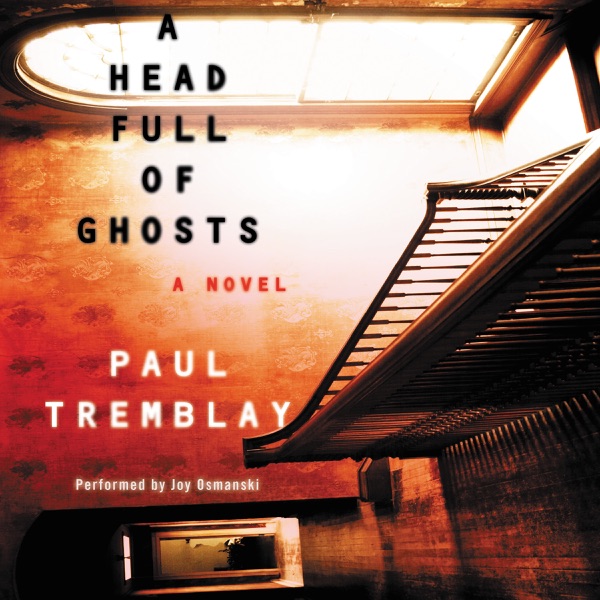


There’s a particular kind of horror that doesn’t chase you down a hallway so much as sit across the kitchen table and quietly ask you to doubt everything you thought you knew. Below is how the A Head Full of Ghosts audiobook actually plays out loud. Paul Tremblay’s A Head Full of Ghosts is that horror, and listening to it on audio turned out to be the exact wrong way to keep my composure and the exact right way to experience the book.
Joy Osmanski narrates this as a grown woman still stuck at eight years old
The whole novel is filtered through Merry Barrett, who was eight when her older sister Marjorie began behaving in ways nobody in the family could explain. Fifteen years later, an adult Merry is recounting it all to a writer. That double vision, the child who lived it and the woman trying to make sense of it, is the trickiest thing about the book, and it’s where narrator Joy Osmanski absolutely earns her keep. She never does a cartoon child voice. Instead she lets a faint brittleness creep into the adult sections and a wide, unguarded openness into the childhood ones, so you can actually hear the gap between what young Merry witnessed and what older Merry now suspects it meant. Over the roughly 8 hours and 49 minutes of runtime, that restraint is what makes the dread accumulate instead of spike.
I’ve listened to a lot of possession stories, and the temptation for a narrator is always to lean into the growls and the theatrics. Osmanski does the opposite. When Marjorie says something genuinely unnerving, she reads it plainly, almost sweetly, and lets your own imagination supply the horror. That choice matters more than any sound effect could.
The reality-TV frame is the scariest thing in the whole story
Here’s the setup that hooked me: the Barrett family, drowning financially and emotionally, agrees to let a cable network film Marjorie’s deterioration and eventual exorcism as a reality series called The Possession. So you’re never just watching a girl who might be sick or might be possessed. You’re watching a family perform that ambiguity for cameras, for a paycheck, for an audience that wants a monster. Tremblay keeps asking whether the show is documenting the horror or manufacturing it, and on audio that question digs in deeper because you’re doing your own listening, your own interpreting, your own hungry watching.
The book also includes blog-post chapters where a horror-blogger character dissects The Possession episode by episode, catching genre references the show is quietly exploiting. Osmanski shifts into a chattier, more knowing register for those, and I found myself weirdly grateful for the tonal break, then unsettled all over again when I realized the blogger is basically me, picking apart a family’s worst days for entertainment.
Get the A Head Full of Ghosts Audiobook on AmazonListen on Audible · also in Kindle & printTremblay refuses to tell you whether it’s demons or illness, and means it
If you need a clean answer about whether Marjorie is possessed or suffering from acute mental illness, this book will frustrate you on purpose. Every supernatural moment has a psychological explanation waiting right beside it, and every psychiatric explanation has a shadow of something older and darker. Tremblay never resolves it. What he does instead is show you a family so desperate and so watched that the truth almost stops mattering, which is a far more upsetting idea than any single explanation would be. This is ambiguity as a deliberate act, not a cop-out, and the audio format made me sit inside the not-knowing rather than skim past it.
Fans of that unresolved dread will recognize the lineage here. Tremblay is openly in conversation with The Haunting of Hill House by Shirley Jackson, and the book name-checks Jackson directly. If you love the way Jackson makes a house feel like a state of mind, you’ll feel right at home in the Barretts’ cramped Massachusetts colonial.
How it sits next to Tremblay’s other work and its horror cousins
I came to this after The Cabin at the End of the World, Tremblay’s later home-invasion nightmare, and it’s fascinating to hear his obsessions in an earlier form here: ordinary families, impossible choices, and a narrator you can’t fully trust. Ghosts is the quieter, more claustrophobic of the two, more interested in the erosion of a household than in a single terrible night.
I’d also point listeners who love a domestic setting with an unreliable child’s-eye view toward Hidden Pictures by Jason Rekulak, which shares that same queasy question of whether a child is seeing something real or something projected. Where Hidden Pictures eventually commits to answers, A Head Full of Ghosts stays maddeningly, brilliantly open.
Who this audiobook is actually for
This is not a jump-scare listen and it’s not a comfort listen. It’s a slow, cerebral unraveling that rewards attention, so save it for walks or dishes rather than a distracted commute where you’ll miss the small tonal shifts Osmanski works so hard to plant. If you like your horror to explain itself by the final chapter, brace yourself. But if the idea of a family, a camera crew, and a girl at the center of an unanswerable question makes the back of your neck prickle, this is close to perfect. It stuck with me for days, which is the only review metric I really trust.
The last few minutes reframe everything that came before, and I genuinely gasped in my kitchen. I won’t say a word more, but I will say the ending is the reason I immediately wanted to start it over.
| Author | Paul Tremblay |
|---|---|
| Narrator | Joy Osmanski |
| Length | 8 hrs and 49 mins |
Three things I’m still turning over
- Do you think the ambiguity works, or do you need a horror novel to eventually pick a side between the supernatural and the psychological?
- Does listening to a possession story on audio, with a narrator interpreting every line for you, make the experience more intimate or does it take away some of the imaginative work?
- Who did you end up trusting most by the end, young Merry, adult Merry, or the cameras, and did that trust survive the final chapter?
Come find me in the comments. I need to talk about that ending with someone.